


Cookie Clicker
4.54.74K Reviews
App Specs
- Version
- 8
- Updated On
- License
- Free
- Downloads
- 5,000,000+
- Developer
- DashNet B.V.
- Categories
- Simulation
- Platform
- Android
Screenshots

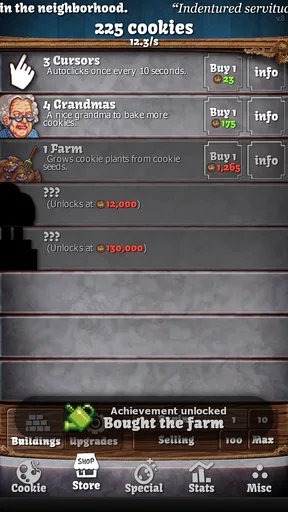

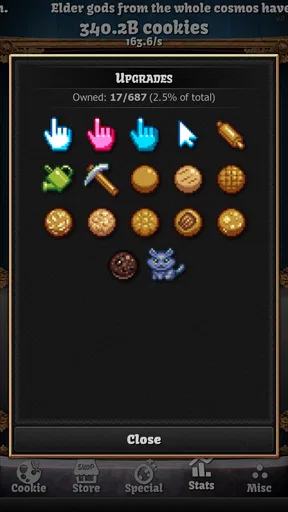


 Analysis by AppCompare
I installed Cookie Clicker expecting a simple tapping distraction, and that first impression lasted only a few minutes. The basic action is obvious: make cookies, spend them on improvements, and let the bakery grow beyond anything that feels remotely practical. What surprised me was how quickly the game turns a tiny repeated action into a long-term planning exercise. It is a simulation game about production, timing, and resisting the temptation to spend every resource immediately.
The central appeal is easy to understand. You begin with a modest cookie supply and gradually build a system that produces more while you are actively playing and while you are away. That makes it suitable for short visits during a commute, a break, or a quiet evening. I can open it, make a few decisions, close it, and return later to see how the bakery has developed. At the same time, it can absorb much longer sessions when I want to examine upgrades and decide which direction to take next.
It is free to play and carries an Everyone age rating, so the presentation is approachable rather than aimed at a narrow audience. DashNet B.V. is the developer, and the game has reached over 5 million installs with a 4.5 average from around 38 thousand ratings. Those figures do not automatically make it a good fit for everyone, but they do reflect how well this unusual little simulation has connected with players who enjoy gradual progress.
How the current version feels in everyday play
The current version is listed as version 8 and supports devices running Android 7.0 or later. I found that useful because the game does not demand the kind of attention associated with a fast action title. Its value comes from returning at the right moments, checking the production chain, and making a choice that improves the next stretch of progress. The interface is built around that loop, so I never had to learn a complicated control scheme before getting started.
A typical session can be very short. I might open the game while waiting for coffee, collect what has accumulated, buy one improvement, and leave. The important detail is that this does not feel like abandoning the game. The bakery continues to matter between visits, which gives each return a small sense of consequence. On a slower day, I can stay longer and compare the immediate benefit of an upgrade with the value of saving for something more expensive.
That choice is where the simulation becomes more interesting than its premise suggests. A purchase that increases production now may be the sensible option when progress feels slow. However, spending too freely can delay a stronger improvement that would have changed the whole pace of the next session. I started treating my cookie balance less like pocket change and more like a budget. The best habit is to spend with a purpose rather than clicking through every available purchase.
The game also works well as a background activity. I do not need sound, reflexes, or a large uninterrupted block of time to enjoy it. It can sit alongside a podcast, a television episode, or a routine task. That makes it different from simulation games that expect constant supervision. Here, the pleasure is partly in watching a system become increasingly self-sufficient.
Worth Reading Before You Choose

EA SPORTS FC Mobile 26 Is a Bigger Football Game, but It Takes Time

Flipboard Shows What News Apps Must Do Beyond the Feed

Switching to Android Auto Means Rethinking Your Driving Routine

Google Calendar Makes a Crowded Week Easier to Manage

Ludo King Makes the Most of the Minutes Between Plans

Baby Panda World Brings Quick Play to Modern Phones, but Its Game Library Feels Busy
There is a trade-off, though. The same relaxed structure that makes it convenient can make the first stages feel repetitive. If I want immediate variety, a dramatic story, or a clear mission every few minutes, this is not the right choice. The game asks me to appreciate accumulation. Players who need frequent surprises may interpret that patience as a lack of content, even though the slow rhythm is the foundation of the experience.
What the progression asks you to manage
Cookie Clicker is not simply about pressing the cookie as quickly as possible. Active clicking matters, especially when the numbers are small, but the longer-term question is how to build a production setup that keeps improving without constant input. I had to decide when manual activity was worth my attention and when it made more sense to let the automated side of the bakery do the work.
That distinction creates a useful two-speed rhythm. During an active visit, I can concentrate on immediate gains and look for an opportunity to make progress faster. During an idle period, the focus shifts to preparation: choosing purchases that will make the next return more productive. A good session therefore begins before I close the game. I try to leave the bakery in a stronger position instead of spending everything simply because I can.
One practical technique is to set a personal spending rule. For example, I may reserve enough cookies for a planned upgrade and use only the remainder for smaller improvements. This prevents the familiar idle-game problem of opening the app with no meaningful decision left to make. The game does not need to tell me this explicitly; the economy teaches it through the consequences of poorly timed spending.
Another useful approach is to compare improvements by role rather than by price alone. A cheaper purchase can be valuable if it supports the way I play during short visits. A more expensive option can be better when I expect to leave the game alone for a while. That means there is no single perfect shopping order for every player. My routine, available attention, and willingness to check in all affect what feels efficient.
I also learned not to judge a session only by the number shown on screen. The satisfying part is seeing the relationship between decisions and output. If I buy something that makes later progress noticeably smoother, the result feels more rewarding than a random burst of cookies. This is why the game works as a simulation rather than merely a button-pressing toy: it gives the growing bakery a sense of internal momentum.
How the game has evolved without losing its identity
The listed release date is October 5, 2020, while the current listing identifies version 8. That combination suggests a product that has continued beyond its initial arrival instead of remaining frozen in its launch state. I see that evolution less as a dramatic reinvention and more as a sign that the core formula has been maintained while the game has moved through later versions.
That distinction matters for an idle game. A complete redesign could easily damage the calm, incremental character that makes it appealing. In my experience, Cookie Clicker still feels focused on its original promise: start with a very small action, expand the production process, and let time become part of the strategy. The version number tells me the app has progressed, but the experience remains recognizable rather than chasing a completely different genre.
For existing players, continuity is valuable. Someone who enjoys checking a bakery over many visits does not necessarily want each update to replace the familiar routine. The current form remains easy to understand after a break, which lowers the cost of returning. I can pick it up again without needing to relearn a complicated system before the game becomes enjoyable.
New players benefit from the same restraint. There is no need to understand every possibility immediately. I recommend spending the first few sessions learning how quickly the bakery grows under different choices instead of trying to optimize everything from the beginning. Early mistakes are useful because they show whether I prefer active clicking, patient accumulation, or a mixture of both.
Still, version evolution does not remove the basic limitation of the genre. More time with an idle game can make progress feel less like a challenge and more like a routine. Once the numbers become large, the emotional reward may depend on personal goals rather than surprise. I enjoyed the sense of scale, but I can also see why a player might eventually feel that the system is running itself.
Who gets the most from the idle format
This is a strong choice for people who like watching small improvements compound. It suits players who enjoy spreadsheets in miniature, resource planning, and the quiet satisfaction of returning to a project that has advanced while they were busy elsewhere. It is also friendly to casual players who do not want to commit to a long story or master difficult controls.
A realistic everyday use case is a student taking short breaks between study sessions. I can open the game for a minute, make one purchase, and close it without losing the thread of what I was doing. The same applies to someone working from home who wants a low-pressure diversion between tasks. The game does not demand a full emotional reset, which makes it easier to fit around ordinary routines.
It is less suitable for someone looking for a competitive multiplayer experience, a rich narrative, or a simulation with detailed construction and visual management. Cookie Clicker gives me a sense of building, but it does not replace a city builder where I lay out roads, solve traffic, or manage a visible population. It also does not offer the immediate tactical tension of a strategy game with opponents reacting to my decisions.
Compared with a conventional tycoon simulation, this game is deliberately abstract. I do not spend time arranging a shop floor or balancing a realistic supply chain. That simplicity is a strength when I want progress without administrative work, but it is a weakness if I want a believable business model. Compared with other idle games, its distinctive advantage is how clearly it exposes the pleasure of compounding: every improvement points back to the same growing production idea.
I would also skip it if I know that repeated loops quickly frustrate me. The game is not hiding its structure. There will be periods when the most sensible action is to wait, return later, and make a measured purchase. That can be relaxing, but it can also feel slow when I am in the mood for constant interaction. A more event-driven simulation would be a better match in that situation.
Small decisions that improve the experience
The first tip I would give a new player is to avoid treating the main cookie action as the entire game. Clicking is the most visible activity, but the more interesting decisions happen around production and timing. I get more from each session when I look at what the bakery will be doing after I leave, not only what it can produce while I am staring at the screen.
Second, I suggest using return visits as checkpoints. Before closing the app, I ask myself what I want the next session to accomplish: reach a purchase, improve passive production, or simply collect and leave. This turns an open-ended idle loop into a sequence of personal objectives. It also reduces the feeling that I am opening the game without a reason.
Third, I would not automatically buy the first affordable improvement. Sometimes a small gain is exactly what I need, but sometimes holding resources for a more meaningful change creates a better rhythm. I compare the immediate convenience with the delay it creates. That trade-off is easy to overlook because the game makes spending feel satisfying in the moment.
A fourth insight is to match the game to my attention level. When I have only seconds, I use it as a collection-and-planning tool. When I have more time, I explore active play and examine how different purchases affect the pace. This prevents me from expecting every visit to feel equally engaging. The game is more enjoyable when I let short and long sessions serve different purposes.
Finally, I recommend accepting imperfect decisions. The scale of the bakery can make optimization feel important, but chasing a flawless path can turn a relaxing game into homework. I prefer to make a reasonable choice, observe the result, and adjust later. That approach preserves the playful side of the simulation while still rewarding careful thought.
Where the experience still has friction
The biggest weakness is repetition. The central action is intentionally narrow, and the game builds depth through accumulation rather than constant mechanical variety. I enjoyed returning to a familiar system, but I would not describe every session as exciting. The experience depends heavily on whether the player finds progress itself entertaining.
Another limitation is that the game can be difficult to evaluate in a single sitting. Early progress gives a clear sense of growth, but the broader appeal comes from continuing the loop over time. That is good for players who like gradual projects and less helpful for anyone deciding quickly whether a game has enough variety. I needed patience before I could tell whether the rhythm suited me.
The abstract presentation may also leave some players wanting more context. The bakery grows, but the game’s pleasure comes from the system rather than from a detailed world or character-driven explanation. I never felt lost, yet I also did not expect the kind of emotional attachment that a story-focused simulation can create.
There is a subtle attention trap as well. Because progress continues between visits, it is easy to develop a habit of checking unnecessarily often. I found the game healthier when I treated it as a small break rather than a task that required constant monitoring. If the thought of missing a tiny improvement becomes stressful, the idle structure is working against the reason to play.
Performance expectations should be modest in another sense: this is not a showcase for complex visual simulation. Its appeal is the economy and the progression loop. Players choosing a game for rich graphics, elaborate animation, or demanding controls should look elsewhere. The restrained approach keeps the focus clear, but it also means visual spectacle is not part of the package.
What returning players and newcomers should watch
Existing users should watch how the current version affects their personal routine rather than assuming that a newer version automatically changes the game dramatically. With version 8 in place, the useful question is whether the familiar loop still gives them meaningful decisions. For me, the answer is yes when I set goals and vary the length of my sessions, but less so when I open it mechanically with no plan.
Newcomers should pay attention to how they feel during the waiting periods. If I enjoy anticipating the next improvement, the game has probably found its audience. If I keep wishing for immediate missions or a more active challenge, no amount of early progress will change the basic identity of the experience. Recognizing that early can save time and point me toward a deeper management simulation instead.
I would also watch the balance between convenience and engagement. Idle progress is the reason the game fits into everyday life, but too much reliance on returning later can make the player feel like an observer. I keep the experience active by making a small plan before each visit and occasionally changing my priorities. Without that habit, the game risks becoming a notification-shaped routine rather than a game I am consciously playing.
The fact that the game remains free is important for trying it without a financial commitment. I can discover whether the slow production loop suits me simply by playing. The Everyone rating also makes it an easy recommendation for a broad audience, although suitability still depends on tolerance for repetition and incremental progress rather than age alone.
After spending time with it, I see Cookie Clicker as a focused simulation rather than a complete replacement for every idle or management game. It does one thing very clearly: it turns accumulation into a satisfying series of choices. If you enjoy gradual growth, short check-ins, and resource decisions that become more interesting over time, this is worth installing. If you need story, competition, detailed construction, or constant novelty, I would choose a different game.
My final recommendation is positive, with one condition: play it on its own terms. Do not expect a traditional bakery simulator or a fast-paced game. Expect a calm, persistent system that rewards patience, planning, and the occasional decision to wait. That narrow focus is also its greatest strength. Once I stopped asking it to be more dramatic than it is, the simple bakery became an unexpectedly effective way to turn a spare minute into a small, ongoing project.
Pros
- Works offline
- so you can keep playing without an internet connection.
- Simple controls make it easy to play with one hand.
- Large upgrade selection supports different progression strategies.
- Frequent achievements give long-term goals beyond cookie production.
- Cloud save support helps protect progress across compatible devices.
Cons
- Progress slows considerably unless you check in regularly.
- The interface can feel crowded after unlocking many upgrades.
- Some features may require watching ads or making in-app purchases.
- Resetting for prestige can make earlier progress feel repetitive.
- Battery use may increase during extended active play sessions.
FAQs for Cookie Clicker
What is Cookie Clicker, and how does the game work?
Cookie Clicker is an incremental game built around producing as many cookies as possible. You begin by tapping or clicking a large cookie, then spend your earnings on cursors, buildings, upgrades, and special bonuses that automate production. As your cookie total grows, the game becomes increasingly focused on planning purchases, improving efficiency, and checking back regularly rather than constant manual tapping.
Can I play Cookie Clicker offline?
Cookie Clicker is generally designed to continue making progress while you are away, although the exact behavior can depend on the version and platform you use. After purchasing production buildings, cookies accumulate automatically, allowing you to return later and collect the results. Some features, advertisements, cloud services, or online-related functions may require an internet connection, so offline availability can vary.
Is Cookie Clicker free to download and play?
Cookie Clicker can be played without paying for the basic gameplay experience, but availability, pricing, and optional purchases may differ between Android and iOS versions. The core progression revolves around earning and spending cookies rather than buying success directly. Before downloading, it is worth checking the store listing for advertisements, in-app purchases, supported devices, and any platform-specific restrictions.
Does Cookie Clicker contain advertisements or in-app purchases?
The presence of advertisements and optional purchases depends on the official mobile version and the store platform. Cookie Clicker’s main mechanics do not require spending money, but some releases may offer optional conveniences, bonuses, or ad-related features. I recommend reviewing the current Google Play or App Store description carefully, especially if you want a completely uninterrupted experience or are installing the game for a child.
Is Cookie Clicker suitable for children and casual players?
Cookie Clicker is easy to understand because its central objective is simply producing cookies, making it approachable for casual players. However, it is intentionally repetitive and can encourage frequent checking to claim rewards and buy upgrades. Parents should review the game’s age rating, advertising, purchase settings, and privacy information before installation. Players who prefer action, story, or fast-changing gameplay may find the incremental format slow.


